Product management · 8 min read
PMs are being hired to build, not just decide what gets built.
We examined 1,551 PM openings. From Meta’s AI workflows to Anthropic’s evaluations, the descriptions get specific about what PMs should do themselves.

What do PM job descriptions ask for?
Some roles combine product ownership with personal prototyping, AI evaluations or implementation. AI use in the PM’s own work appears in 26 of 28 Meta descriptions and all nine Coinbase descriptions. Evaluation work is more often explicitly assigned than coding or building working systems. Other roles emphasize design or commercial judgment. Coding is not a universal requirement.
Get the next analysis
Research, product launches, and evidenso updates.
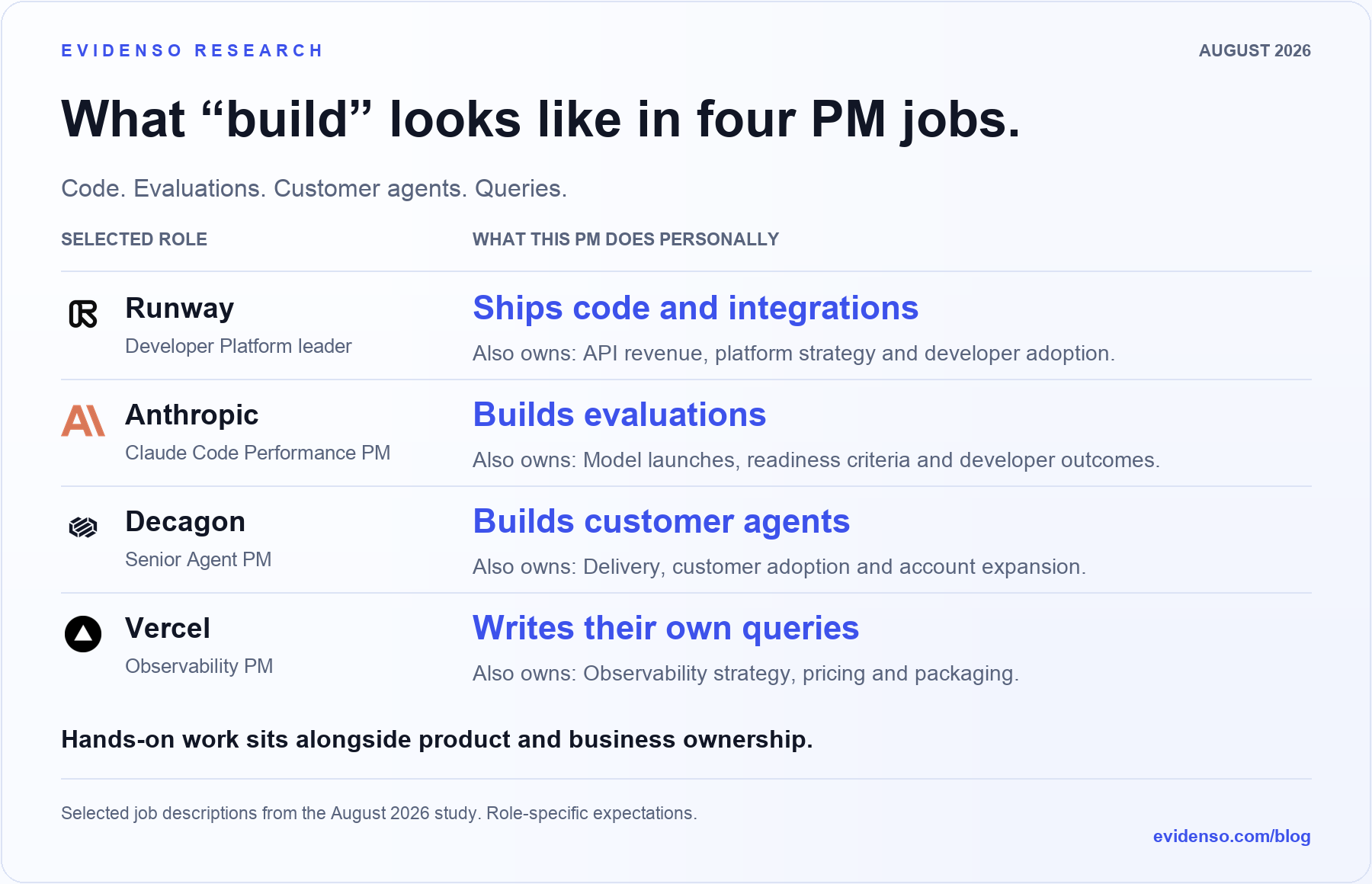
Runway wants a product leader who ships code. Anthropic wants a PM who builds evaluations for Claude Code. Decagon wants PMs who build working agents for customers.
Each role also owns product decisions: what to prioritize, how to judge quality, and whether the work delivers value. The hands-on work sits alongside that responsibility. Runway, Anthropic, Decagon.
Our first study looked at who was hiring PMs. This time, we wanted to understand how expectations of the role are changing. We returned to the 1,551 PM openings across 87 companies to see what employers actually ask PMs to do, which skills they look for, and what experience counts.
The most revealing descriptions went beyond years of experience and products launched. They specified something the PM would make, test or investigate personally.
These roles ask for product judgment you can demonstrate. The evidence might be a prototype, an evaluation or a working agent. What matters is how that work helps the PM decide what deserves to be built.
Building is broader than coding
We found 619 openings mentioning at least one of five kinds of hands-on work, about 40% of the 1,545 job descriptions we analyzed.
Some of that work, such as querying product data, is familiar PM territory. The more revealing details are the requests for personal implementation, recent agent-building experience and examples of AI use in interviews.
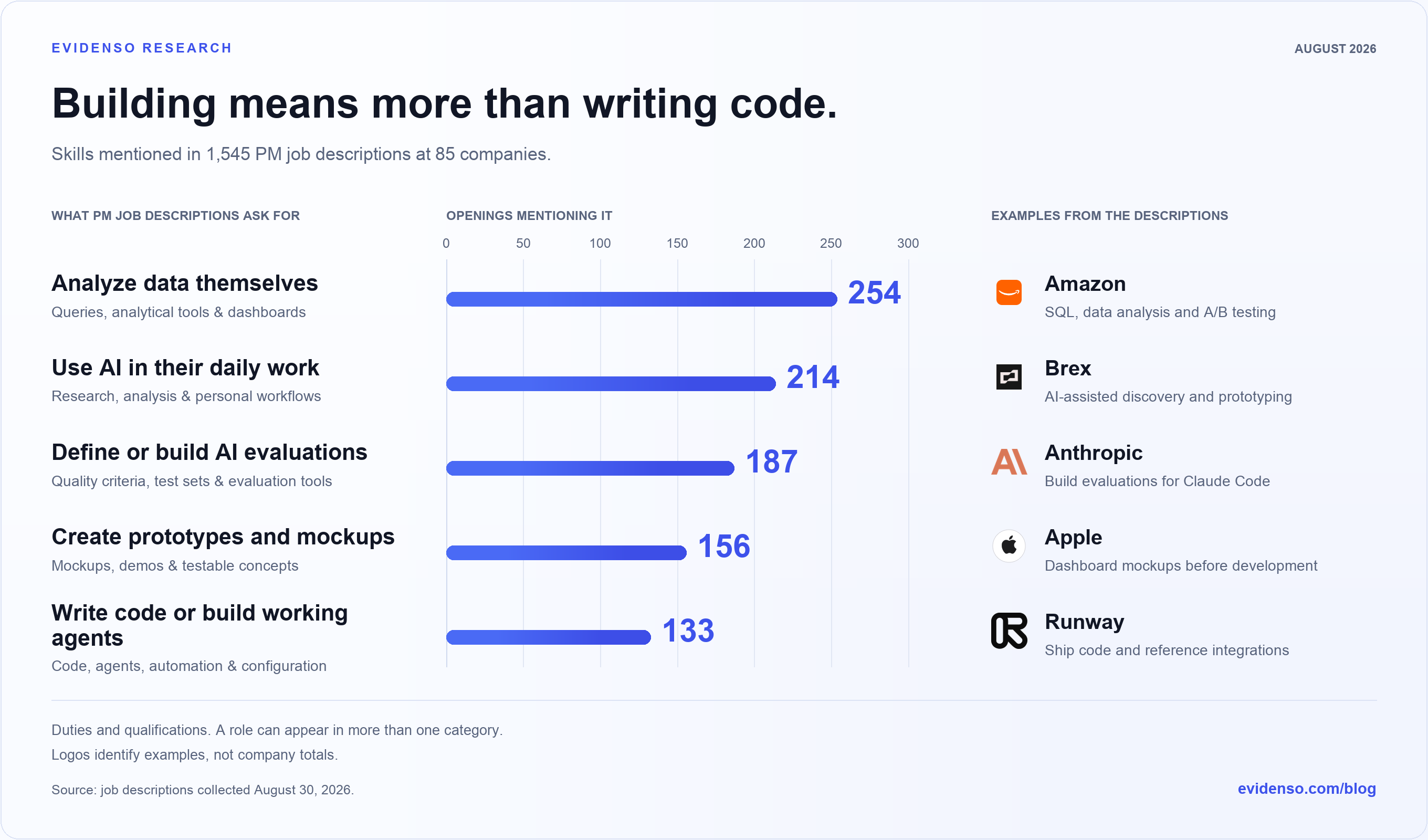
What companies mean by “build”
A customer agent, a model evaluation and a dashboard mockup require different expertise. The job descriptions are most useful when they explain what the PM must do personally, and why.
AI fluency isn’t just for “AI PMs”
26 of Meta's 28 PM descriptions mention using AI in the PM's own work. That includes Facebook, Risk, infrastructure capacity and leadership roles, not just jobs building AI products. The expectations go beyond trying a chatbot: they include redesigning workflows and demonstrating improvements in efficiency or quality. Meta · Product Manager, Facebook.
All 9 Coinbase PM descriptions include an expectation to use generative AI responsibly, with human oversight, to improve workflow efficiency, cost or quality. The same wording appears across roles. At these employers, AI fluency looks like a broad hiring expectation, rather than a specialty reserved for an AI PM. Coinbase · Senior PM, CX & AI Tooling.
“I've managed an AI product” and “I use AI to do better product work” answer different questions. These descriptions ask about the second one too.
Testing an idea before asking engineering to build it
One reason to use those tools is to test an idea without waiting for a team to build it.
Amazon calls one role a “Non-Tech” Senior PM, then asks that person to build AI-assisted, no-code or low-code prototypes before committing engineering resources. The title doesn't tell the whole story. Amazon.
The prototype has a job to do: expose a weak assumption while changing direction is still relatively cheap. That's different from taking over the engineering team's production work.
Deciding whether the AI is good enough
Evaluation work stood out for how clearly it was assigned. Of the 187 descriptions mentioning AI evaluations, 166 put that work in the responsibilities: 89%. For coding or building working systems, it was 46 of 133, or 35%. Some mentions instead described qualifications or prior experience, including preferences.
This isn't a clean split between evaluators and coders: building an evaluation can involve code. The useful distinction is between a skill on the candidate checklist and work the PM is explicitly hired to do.
At Anthropic and OpenAI, a shared theme is making AI quality measurable. Anthropic's Claude Code PM would personally build evaluations of coding performance. OpenAI's Safety Measurement PM would define how to measure harm and whether safeguards work. Airbnb's Conversational Products role also owns evaluation strategy, including testing against live traffic and tools that let non-engineers improve the assistant safely. Anthropic, OpenAI, Airbnb.
Defining the standard and implementing the test are different tasks. Both require a product decision about what counts as good enough. A demo that looks impressive is not yet an answer to that question.
Sometimes, the PM ships the software too
Decagon's Senior Agent PM builds a working customer agent and owns delivery, adoption and expansion. Runway's Developer Platform product leader ships code and integrations while owning API revenue and platform strategy. Decagon, Runway.
5 of Mercor's 6 saved PM listings ask for small code contributions, including roles in Mobile, Payments and Trust & Safety. That is a repeated expectation at one employer. Mercor's general PM listing.
The outputs differ, but implementation and product ownership sit in the same job description.
evidenso research
What “build” looks like in four PM jobs.
Code. Evaluations. Customer agents. Queries.
 Runway
Developer Platform leader
Ships code and integrations
Also owns: API revenue, platform strategy and developer adoption.
 Anthropic
Claude Code Performance PM
Builds evaluations
Also owns: Model launches, readiness criteria and developer outcomes.
 Decagon
Senior Agent PM
Builds customer agents
Also owns: Delivery, customer adoption and account expansion.
Observability PM
Writes their own queries
Also owns: Observability strategy, pricing and packaging.
Hands-on work sits alongside product and business ownership.
Job descriptions & sources (4)
- Runway · Developer Platform leader
“ship your own PRs and reference integrations”
- Anthropic · Claude Code Performance PM
“Design and implement agentic evals”
- Decagon · Senior Agent PM
“then build the working AI agent”
- Vercel · Observability PM
“you write your own queries”
Hands-on work is not confined to junior PMs
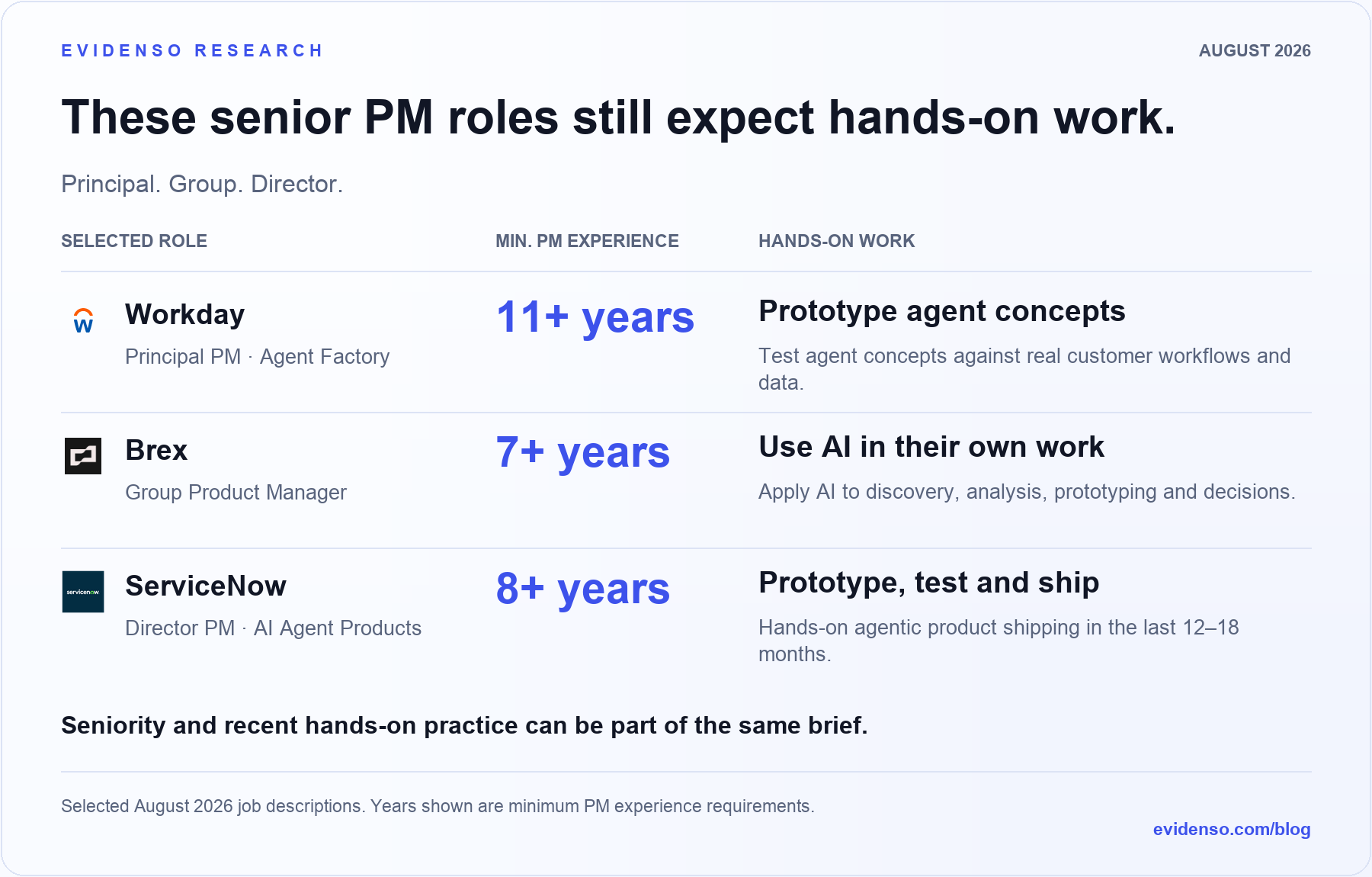
Workday's Agent Factory role requires at least eleven years of PM experience and still expects personal prototyping before engineering investment. Brex's Group PM manages and develops PMs while applying AI to discovery, analysis, prototyping and decisions. Workday, Brex.
ServiceNow adds another revealing detail. Its AI Agent Products Director description asks for at least eight years of PM experience, alongside recent hands-on experience shipping agentic products in the preceding twelve to eighteen months. The description puts it bluntly:
“Years of PM tenure matter far less than what you've shipped recently and how deep you've gone technically.”
ServiceNow · Director, Product Management, AI Agent Products.
For an experienced PM, that's a specific challenge. You need to explain the decisions you've led and show that you can still get close enough to the work to test your assumptions.
evidenso research
These senior PM roles still expect hands-on work.
Principal. Group. Director.
Principal PM · Agent Factory
11+years
Prototype agent concepts
Test agent concepts against real customer workflows and data.
Group Product Manager
7+years
Use AI in their own work
Apply AI to discovery, analysis, prototyping and decisions.
 ServiceNow
Director PM · AI Agent Products
8+years
Prototype, test and ship
Hands-on agentic product shipping in the last 12–18 months.
Seniority and recent hands-on practice can be part of the same brief.
Job descriptions & sources (3)
- Workday · Principal PM · Agent Factory
“Our PMs prototype with their own hands”
- Brex · Group Product Manager
“use AI tools aggressively in your own work”
- ServiceNow · Director PM · AI Agent Products
“Actively prototype, experiment, and ship”
Use AI. Understand the work without it.
Adobe's Senior PM role in Knowledge & Retrieval asks for vibe-coded prototypes, with Claude Code preferred. Further down the same posting, its interview policy says AI tools aren't permitted during live interviews unless the interviewer invites them or an accommodation is approved in advance. Adobe.
Mercor makes the distinction within the qualifications themselves. Its Applied AI PM should be familiar with coding agents and comfortable using SQL/Python “without agent assistance as well.” Mercor · Applied AI PM.
These aren't instructions to avoid AI. They're asking for evidence of the person's own skill and thinking as well as fluency with the tools. For a PM, that matters when an output looks convincing but rests on the wrong assumption.
The same company can want different kinds of PMs
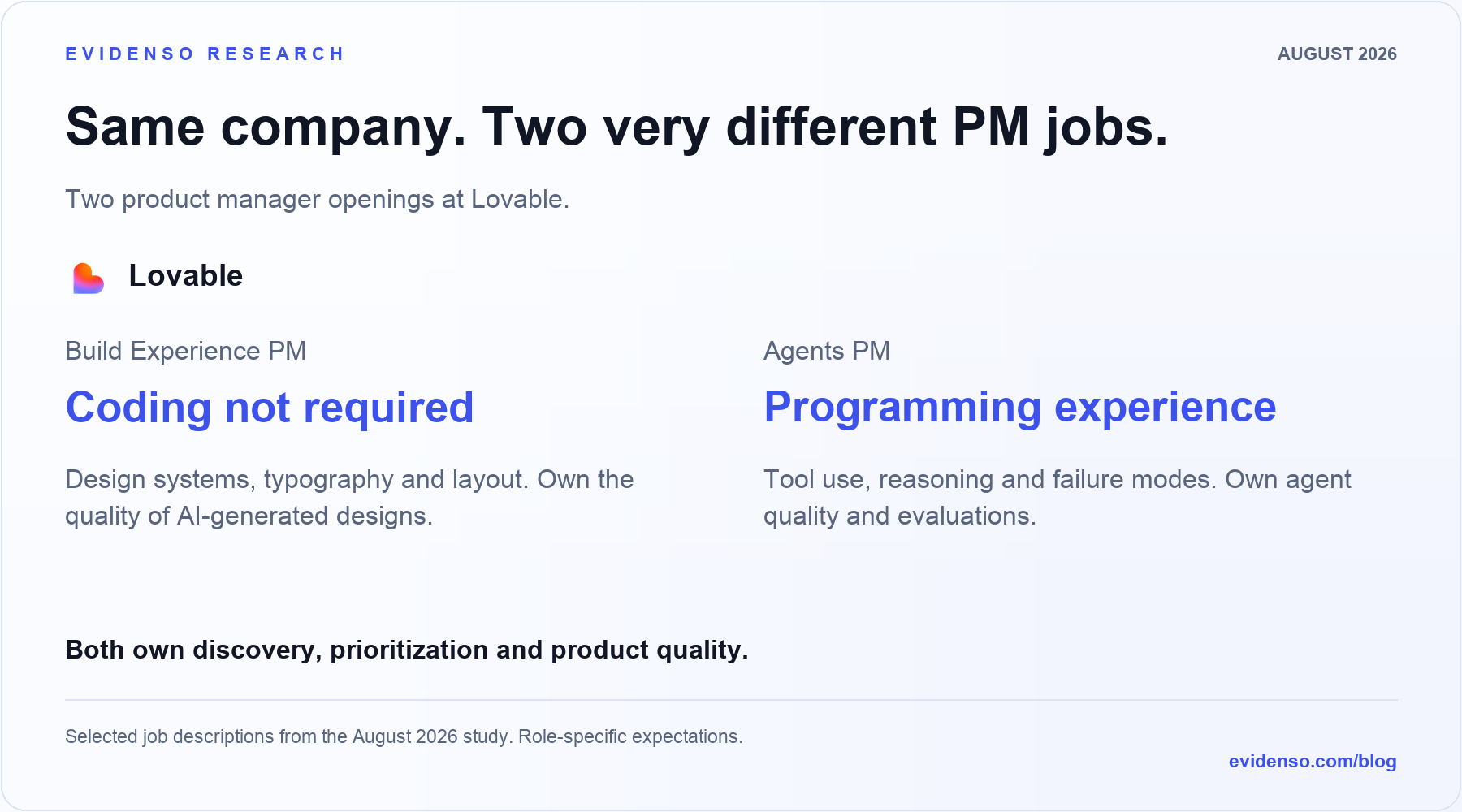
What you need to understand depends on the product. Lovable's Build Experience PM description says coding is not required. It asks for expertise in design systems, typography, layout and the quality of AI-generated designs.
Its Agents PM description asks for current or past programming experience and hands-on agent-building experience, with an understanding of tool use, reasoning and failure. Build Experience, Agents.
Both own discovery, prioritization and quality. The expertise needed to make good decisions differs.
evidenso research
Same company. Two very different PM jobs.
Two product manager openings at Lovable.
 Lovable
Build Experience PM
Coding not required
Design systems, typography and layout. Own the quality of AI-generated designs.
Agents PM
Programming experience
Tool use, reasoning and failure modes. Own agent quality and evaluations.
Both own discovery, prioritization and product quality.
Job descriptions & sources (2)
- Lovable · Build Experience PM
“you don't need to code”
- Lovable · Agents PM
“you program or have programmed”
Preparing for these two jobs would mean demonstrating different strengths. The company name and PM title alone wouldn't tell you which ones.
What about the other 60%?
The remaining 926 descriptions didn't explicitly name any of the five capabilities we counted. That tells us what the posting says, not everything the job involves.
Stripe's Enterprise Staff PM explicitly doesn't need to write code. The role still owns industry strategy, technical trade-offs, revenue, adoption and customer satisfaction. Stripe.
Personal implementation and product ownership are different questions. Writing code is a poor way to rank the importance of these jobs.
What to bring to your next PM interview
Sometimes the relevant experience doesn't come with a previous PM title. Anthropic's Claude Code Model Performance role accepts an engineering background with two-plus years in PM, or equivalent experience driving product direction as an engineer. Fireworks' Associate PM role targets candidates with under two years of professional experience, but already expects them to have been building with AI APIs and vibe coding. Anthropic, Fireworks AI.
You can be new to the title without being new to the work. And if you've held the title for years, the work still needs explaining.
Pendo's Analytics PM description asks for experience with AI prototyping or code-generation tools to validate ideas before engineering investment, with specific examples of AI use expected in the interview. Figma's Developer Platform PM description asks what candidates personally built and shipped, and which quality metrics they improved. Pendo, Figma.
Prepare one example you can explain in detail:
- What customer problem or uncertainty were you trying to resolve?
- What did you personally make, test or investigate?
- What did you learn, and how did it change the product decision?
A prototype that persuaded you to abandon a feature can be worth discussing. So can an evaluation that exposed a failure, or a customer conversation that changed the scope. Explain the judgment the work made possible.
What this could mean for the future of PM
Building can bring product judgment into contact with reality sooner. A query tests a hunch about usage. A prototype exposes a misunderstood workflow. An evaluation reveals where an impressive demo stops being useful.
For PMs, the opportunity is to carry more of that investigation themselves. Bring a testable idea to a customer. Try the workflow. Understand the failure. Then work with engineering and design on what deserves a larger investment. Knowing when to bring in their expertise is part of the judgment too.
That's the future of PM work I'd bet on: a stronger building component, tied closely to customer understanding and decisions about where to invest. The value lies in what the work helps you learn, rather than how much code you produce.
Our first study asked where product judgment lives. This one leaves me with a more practical question:
What could you make, test or investigate that would change your next product decision?
How we researched this
We started with the 1,551 PM openings at 87 companies identified in our August 30, 2026 study. The counts above use 1,545 job descriptions from that collection, across 85 companies. Missing, conflicting and later-retrieved descriptions are excluded.
We counted explicit duties and candidate qualifications, including preferred skills, rather than generic claims about being “technical” or “data-driven.” Company-wide culture statements were excluded; explicit role qualifications repeated across an employer's postings were retained. We reviewed the supporting passages and checked 240 descriptions in full across company categories, alongside the named examples.
Duties and qualifications. A role can appear in more than one category.
| What PM job descriptions ask for | Openings mentioning it |
|---|---|
| Analyze data themselvesWrite queries, investigate usage, answer product questions directly. | 254 |
| Use AI in their daily workApply AI to research, analysis, discovery and prototyping. | 214 |
| Define or build AI evaluationsSet quality criteria, design tests and assess model failures. | 187 |
| Create prototypes and mockupsMake an idea tangible before committing to development. | 156 |
| Write code or build working agentsMake small code changes, write scripts or implement customer agents. | 133 |
Amazon accounts for 154 of the 254 data-analysis mentions, so that count doesn't tell us what a typical employer wants. But the broader finding holds without Amazon: about 40% of the remaining descriptions still mention at least one capability.
Each opening counts once per capability. For the responsibilities comparison, we counted descriptions with at least one passage explicitly assigning that activity to the role. The evaluation-versus-implementation contrast held without Amazon and with identical description templates counted once per company. Job descriptions can omit responsibilities, and interpreting them involves judgment. The findings describe these postings, not the whole PM job market or a measured change over time.
We build product discovery tools for PMs at evidenso, so we were curious too.
Subscribe to product and research insights about the future of product management.
Original research, practical ideas, and new product releases to help you navigate how product management is changing.